








Inventory management is the process of tracking and controlling the flow of company inventory: from purchasing and storing to selling. This includes raw materials, components and parts, and finished goods, all tracked from initial purchase through final sale. The goal? Keeping the right amount of stock on hand, in the right place, to consistently meet customer demand.
Insufficient inventory management and increased inventory distortion cause $1.1 trillion in loss worldwide every year. Despite this staggering statistic, inaccurate supply chain and inventory levels and inadequate inventory tracking are near-universal problems for small and large businesses alike.
Proper stock control is crucial for sourcing, storing, and selling goods at the right cost and price. Failing to prioritize inventory organization can be detrimental to the success of any business — no matter its reputation, name, or size.
This guide unpacks inventory management, why it’s important, and the essential steps for optimizing and managing inventory.
Key Takeaways
-
Inventory management is the holistic process of sourcing, storing, and selling inventory. It covers tracking goods during manufacturing and sourcing until the final product is in the customer's hands.
-
Inventory turnover ratio measures the rate at which goods are purchased, used, and sold and is a primary KPI for overall supply chain management.
-
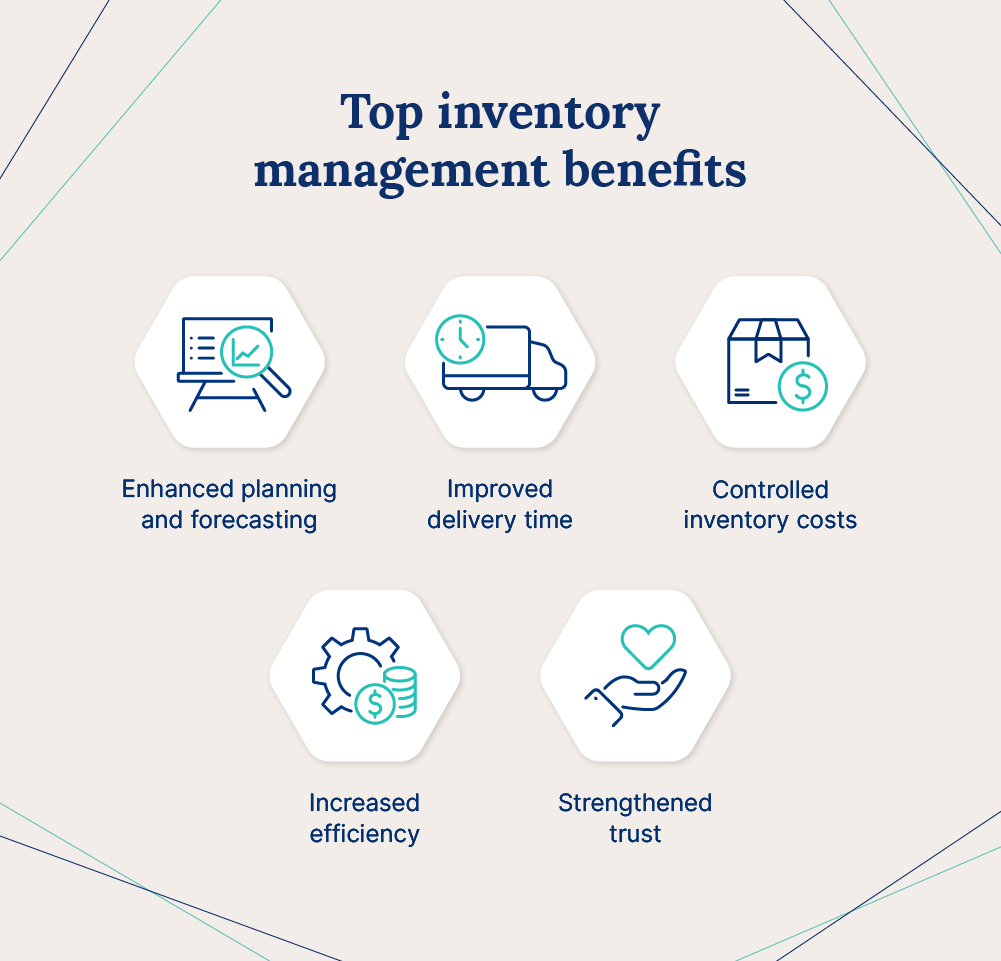
Successful inventory management benefits companies by enhancing planning and forecasting, improving delivery times, controlling inventory costs, boosting efficiency, and strengthening trust.
-
Common inventory management challenges are inventory shrinkage, deadstock, out-of-stock inventory, demand changes, and poor use of warehouse space.
What is Inventory Management?
Inventory management is the process of controlling inventory at every lifecycle stage, from sourcing to storing to selling. This term also covers the theories, processes, and tools used to move goods from one stage to another. The core purpose of this process is to ensure you have the right amount of stock on hand at the right time and cost.
When it's done well, you reduce stockout risks that disappoint customers. You also avoid overstocking, which ties up capital and cuts into profits. It also helps your business stay agile when demand fluctuates, supply chains hit snags, or other unexpected challenges pop up.
Why is Inventory Management Important?
Inventory management is important because it directly connects to your ability to meet customer demand, manage cash flow, and grow profitably. At its core, it's a balancing act. Your finance team wants to minimize capital tied up in unsold stock. Your sales team needs guaranteed product availability to keep customers happy. Without a system to manage that tension, things fall apart fast.
Satisfied customers and market demand depend on accurate inventory counts and organization. Businesses use many metrics — including inventory turnover ratio — to measure how well their inventory management systems are performing. And if your inventory isn't managed properly, storage, manufacturing, and shipping costs can quickly spiral out of control.
Types of Inventory
There are three main types of inventory: raw materials, work-in-progress goods, and finished goods. However, further classifications can clarify the status of a product at any time.
It's worth noting that for most businesses, inventory represents their primary source of revenue. On your balance sheet, it's recorded as a current asset, and its value reflects the cost to acquire or produce those goods. That's why understanding each type of inventory matters. It's not just about what's in the warehouse, it's about what's on your books.
The nine most common types of inventory in inventory management are listed in the table below.
| Inventory types | |
|---|---|
| Raw materials | Materials or purchased parts that make up finished products |
| Work-in-process (WIP) goods | Partially completed goods in the process of becoming finished goods |
| Finished goods | An industry or company’s completed product that is ready to be sold |
| Transit inventory | Inventory, also known as pipeline inventory, that is in transit from the manufacturer’s place to the retailer or wholesaler shop |
| Safety stock | Extra inventory that can mitigate customer service problems, backorders, stockouts, unexpected costs, and uncertainties in demand, lead time, and supply variations |
| Anticipation inventory | Additional stock designed to protect a company from unprecedented consumer demand during a certain period |
| Decoupling inventory | Extra raw materials or WIP goods that are set aside to avoid production interruptions |
| Cycle inventory | The portion of total inventory that is constantly turned over and replaced with new stock; it’s also considered the minimum stock needed to maintain quotas |
| MRO (maintenance, repair, and operation) inventory | The products that support the production process of the finished goods, such as lubricants, screws and ball bearings, gloves, and packing materials |
Benefits of Inventory Management
Having the right products available at the right time in the right quantities to meet customer needs is the key to achieving a company’s objectives. Inventory management and control help do just that, which also curbs profit loss and helps businesses thrive.
Additionally, stock management for small businesses and large businesses produce other benefits, including:
- Enhanced planning and forecasting: Inventory tools help you identify top performers and shelf-eaters, improving revenue and freeing up cash flow.
- Improved delivery time: Properly arranged and tracked inventory helps protect you from mismanagement, and expedited delivery can increase customer satisfaction.
- Reduced inventory costs: Inventory management allows you to accurately order and reorder products and materials, which decreases costs associated with backstock and storage.
- Increased efficiency: Effective systems prioritize systemic management so you can track the products and their quantities efficiently.
- Strengthened trust: Accurate stock numbers build trust with manufacturers, employees, and customers across every stage of the supply chain.
Inventory Management Best Practices
Knowing the benefits of good stock control is one thing. Putting them into practice is another. Here are some best practices that'll help you get the most out of your operations:
- Run routine audits: Regular stock checks keep your system accurate and help you catch discrepancies before they become real problems.
- C
The best practices for inventory management all start with one idea: tracking and controlling the flow of company inventory, from purchasing and storing to selling. That flow includes raw materials, components and parts, and finished goods, all tracked from initial purchase through final sale. The goal? Keeping the right amount of stock on hand, in the right place, to consistently meet customer demand.
Insufficient inventory management and increased inventory distortion cause $1.1 trillion in loss worldwide. Despite this staggering statistic, inaccurate supply chain and inventory levels and inadequate inventory tracking are near-universal problems for small and large businesses alike.
Proper stock control is crucial for sourcing, storing, and selling goods at the right cost and price. Failing to prioritize inventory organization can be detrimental to the success of any business, no matter its reputation, name, or size.
This guide unpacks inventory management, why it's important, and the essential steps for optimizing and managing inventory.
Key Takeaways
- Inventory management is the holistic process of sourcing, storing, and selling inventory. It covers tracking goods during manufacturing and sourcing until the final product is in the customer's hands.
- Inventory turnover ratio measures the rate at which goods are purchased, used, and sold and is a primary KPI for overall supply chain management.
- Successful inventory management benefits companies by enhancing planning and forecasting, improving delivery times, controlling inventory costs, boosting efficiency, and strengthening trust.
- Common inventory management challenges are inventory shrinkage, deadstock, out-of-stock inventory, demand changes, and poor use of warehouse space.
What Is Inventory Management?
Inventory management is the process of controlling inventory at every lifecycle stage, from sourcing to storing to selling. This term also covers the theories, processes, and tools used to move goods from one stage to another. The core purpose of this process is to ensure you have the right amount of stock on hand at the right time and cost.
When it's done well, you reduce stockout risks that disappoint customers. You also avoid overstocking, which ties up capital and cuts into profits. It also helps your business stay agile when demand fluctuates, supply chains hit snags, or other unexpected challenges pop up.
Why Is Inventory Management Important?
Inventory management is important because it directly connects to your ability to meet customer demand, manage cash flow, and grow profitably. At its core, it's a balancing act. Your finance team wants to minimize capital tied up in unsold stock. Your sales team needs guaranteed product availability to keep customers happy. Without a system to manage that tension, things fall apart fast.
Satisfied customers and market demand depend on accurate inventory counts and organization. Businesses use many metrics, including inventory turnover ratio, to measure how well their inventory management systems are performing. And if your inventory isn't managed properly, storage, manufacturing, and shipping costs can quickly spiral out of control.
Types of Inventory
There are three main types of inventory: raw materials, work-in-progress goods, and finished goods. However, further classifications can clarify the status of a product at any time.
It's worth noting that for most businesses, inventory represents their primary source of revenue. On your balance sheet, it's recorded as a current asset, and its value reflects the cost to acquire or produce those goods. That's why understanding each type of inventory matters. It's not just about what's in the warehouse, it's about what's on your books.
The nine most common types of inventory in inventory management are listed in the table below.
Type Definition Raw materials Materials or purchased parts that make up finished products Work-in-process (WIP) goods Partially completed goods in the process of becoming finished goods Finished goods An industry or company's completed product that is ready to be sold Transit inventory Inventory, also known as pipeline inventory, that is in transit from the manufacturer's place to the retailer or wholesaler shop Safety stock Extra inventory that can mitigate customer service problems, backorders, stockouts, unexpected costs, and uncertainties in demand, lead time, and supply variations Anticipation inventory Additional stock designed to protect a company from unprecedented consumer demand during a certain period Decoupling inventory Extra raw materials or WIP goods that are set aside to avoid production interruptions Cycle inventory The portion of total inventory that is constantly turned over and replaced with new stock; it's also considered the minimum stock needed to maintain quotas MRO (maintenance, repair, and operation) inventory The products that support the production process of the finished goods, such as lubricants, screws and ball bearings, gloves, and packing materials Benefits of Inventory Management
The benefits of effective inventory management come down to this: you get the right products, in the right quantities, in the right place, at the right time to meet customer needs and hit your goals. Inventory management and control help do just that, which also curbs profit loss and helps businesses thrive.
Additionally, stock management for small businesses and large businesses produce other benefits, including:
- Enhanced planning and forecasting: Inventory tools help you identify top performers and shelf-eaters, improving revenue and freeing up cash flow.
- Improved delivery time: Properly arranged and tracked inventory helps protect you from mismanagement, and expedited delivery can increase customer satisfaction.
- Reduced inventory costs: Inventory management allows you to accurately order and reorder products and materials, which decreases costs associated with backstock and storage.
- Increased efficiency: Effective systems prioritize systemic management so you can track the products and their quantities efficiently.
- Strengthened trust: Accurate stock numbers build trust with manufacturers, employees, and customers across every stage of the supply chain.
Inventory Management Best Practices
Knowing the benefits of good stock control is one thing. Putting them into practice is another. Here are some best practices that'll help you get the most out of your operations:
- Run routine audits: Regular stock checks keep your system accurate and help you catch discrepancies before they become real problems.
- Collaborate with suppliers: Active communication with your vendors improves lead times and keeps your restock game on point.
- Use clear labeling: Proper labels and barcodes make it easier to find, track, and move products through your warehouse.
- Categorize by demand: Group items based on how fast they move and how much space they need. This helps you prioritize what matters most.
- Organize your warehouse: An efficient layout speeds up picking, packing, and shipping, which means happier customers and fewer headaches.
- Lean into automation: Modern inventory systems handle repetitive tasks like reorder alerts and stock updates so your team can focus on growth.
Stick with these, and you'll have much tighter control over your stock and a smoother operation from end to end.
Common Mistakes to Avoid
Best practices are only half the story. Here are the mistakes that trip up the most businesses, so you can steer clear of them:
- Skipping safety stock: Running lean feels efficient until one demand spike leaves you out of stock and scrambling.
- Relying on manual tracking: Spreadsheets don't scale, and every manual entry is a chance for a costly error.
- Ignoring slow movers: Deadstock quietly ties up cash and shelf space, so watch your slow sellers and act early.
- Skipping regular audits: Without periodic counts, small discrepancies snowball into stockouts and shrinkage you never see coming.
Inventory Management Challenges
With so many moving parts, it's no surprise that inventory management also has its challenges. Some of the most common challenges include:
- Inventory shrinkage: Unforeseen circumstances like theft or vendor error cause stockouts and loss of inventory.
- Deadstock: Incorrect forecasting and demand dips create stock that never sells, clutters systems, and blocks cash flow.
- Out-of-stock inventory: A business exhausts its stock of a particular good or service, decreasing revenue and credibility.
- Demand changes: A shift in customer demand for a specific good or service leads to deadstock or stockouts.
- Poor use of warehouse space: Inefficient warehouse layouts negatively impact workflows, supply chain performance, and shipping times.
Despite these challenges, it's possible to minimize or even solve many inventory management roadblocks with proper organizational systems. Consider implementing the following solutions to common challenges so you can prevent issues, and meet them head-on.
How Supplier Relationships Improve Your Inventory
Your suppliers aren't just vendors; they're partners. And the stronger those partnerships are, the better your inventory management gets.
When you've built solid relationships with your suppliers, you're in a much better position to negotiate favorable terms on order quantities and delivery schedules. That means your inventory levels stay more closely aligned with actual demand, and you're not overspending on stock you don't need.
Close supplier partnerships can also shorten lead times and improve the accuracy of your stock predictions, which makes your whole supply chain more responsive. When the market shifts or customer preferences change, you can adjust quickly instead of scrambling. The result? Fewer disruptions, better returns on your inventory investments, and customers who keep coming back.
The Inventory Management Process
The inventory management process is the repeatable cycle of sourcing, receiving, storing, tracking, and reordering stock so the right products are always ready to sell. It may not be the most glamorous part of running a business, but it's crucial, to say the least. Many businesses manage stock levels and product movement in spreadsheets, even as companies outgrow manual tools.
While it may come as a surprise, you're likely not cutting any costs by manually tracking inventory on spreadsheets. Between time loss and human error, your business might be ready to move on, requiring you to invest in solutions that enable real growth.
No matter your current stock control process, inventory management software is a critical investment. It simplifies product and material tracking, giving you more control over your business.
How Inventory Management Software Works
At its simplest, an inventory management process works by answering three questions in real time: Where are your items right now? Where are they headed? And when do you need more?
With an automated, all-in-one system like Cin7 Core or Cin7 Omni, you get real-time visibility into your inventory. This helps you improve your supply chain, keep customers happy, and minimize inventory loss.
These systems handle inventory-related tasks across various inventory management methods with ease. With convenient back-end management across multiple channels, locations, and currencies, inventory management systems can automate the entire e-commerce operations process. Thanks to our 700+ integrations, you can also sync inventory across every sales channel you sell on, from Shopify and Amazon to your POS and accounting tools, so a sale in one place updates your stock everywhere without you lifting a finger.
Inventory Management Methods
Selecting an inventory management method isn't one-size-fits-all, so you'll need to pick the method that suits your business best. There are various ways to manage inventory. Choose the best inventory management technique for your goals:
- ABC analysis: Separates inventory into three categories based on required revenue and control measures. Also known as the 80/20 rule.
- Demand forecasting: Predicts future customer demand for goods and services based on historical data.
- Economic order quantity (EOQ) formula: Prevents over- or understocking and minimizes capital investments in purchasable products.
- Fast, slow, non-moving (FSN) inventory: Separates products based on consumption, quantity, and the rate at which inventory gets used.
- First-in-first-out (FIFO): Sells the oldest stock, inventory that entered the warehouse first, first.
- Just-in-time (JIT) inventory: Keeps inventory available at the right time and place, without overstocking.
- Last-in-first-out (LIFO): Sells goods most recently produced or purchased first, similar to FIFO in structure.
- Perpetual inventory method: Consistently tracks inventory as it moves through the supply chain.
- Periodic inventory management: Monitors inventory at specific intervals during an accounting period, rather than after every sale.
- Two-bin inventory control: Two identical bins hold components; when the first empties, it signals time to reorder.
- Vendor-managed inventory (VMI): A vendor maintains agreed inventory levels at buyer locations on your behalf.
- Materials requirement planning (MRP): Uses sales forecasts and production schedules to calculate what materials you need and when, avoiding shortages and excess stock.
- Days' sales of inventory (DSI): Measures how many days it takes to turn inventory into sales. Lower numbers mean faster sell-through.
- Dropshipping: You hold no inventory; suppliers ship directly to customers when orders are placed. It cuts warehousing costs but requires strong supplier coordination.
Inventory KPIs and Forecasting Every Business Should Track
Inventory KPIs are the metrics that tell you whether your stock is working for you or against you, and forecasting is how you use them to plan ahead. You can't improve what you don't measure, so these are the numbers worth watching closely.
Inventory Turnover Ratio
Inventory turnover ratio measures how many times you sell through and replace your stock over a set period. You calculate it by dividing the cost of goods sold by your average inventory. A higher number usually means healthy demand and lean stock, while a low number can signal overstocking or slow movers eating into your cash flow.
Days' Sales of Inventory (DSI)
Days' sales of inventory tells you the average number of days it takes to sell through your current stock. It's the flip side of turnover: the lower your DSI, the faster your products are moving. Watch it climb, and you'll spot slow sellers before they turn into deadstock.
Sell-Through Rate
Sell-through rate compares how much you sold to how much you received, usually over a month. Divide units sold by units received, then multiply by 100. It's a quick gut-check on whether you ordered the right amount, and it helps you fine-tune your next purchase order.
Forecast Accuracy
Forecast accuracy measures how close your demand predictions came to actual sales. The tighter that gap, the less you'll overstock or run out. When you pair historical data with AI-driven demand forecasting, you can sharpen these predictions over time and plan reorders with real confidence instead of guesswork.
What Is an Inventory Management System?
An inventory management system is the set of physical and digital processes and tools businesses use to track, record, and analyze inventory movements and sales performance across the supply chain. It gives you one reliable place to see what you have and how it's moving.
Modern systems go well beyond simple stock counts. They combine data-driven models with your business rules to align suppliers, lead times, and market fluctuations with your goals.
It's no wonder more companies are investing in them. According to Grand View Research, the inventory management software market is projected to reach $7.14 billion by 2033, up from $3.58 billion in 2024.
The best inventory management software tools provide visibility into stock levels, connections to additional sales channels, and reorder processes. These tools automatically track your inventory levels and streamline key activities. These include procurement, production, reporting, forecasting, selling, and order fulfillment.
Pro tip: Your business can leverage Cin7 Core and Cin7 Omni to efficiently perform inventory management tasks and support supply chain resilience.
Why Effective Inventory Management Matters
Effective inventory handling is a crucial success factor that touches all other elements of your business, from the customer experience to your finances. To better understand its impact, let's unpack the effects of effective inventory management:
- Less human error: Automatic data inputs reduce manual errors that lead to stockouts, lost inventory, and other costly mistakes.
- Decreased manual work: Low-performing inventory software and manual spreadsheet upkeep are eliminated, which means your team can focus on growth rather than running inventory.
- Simplified scaling: Efficient inventory management removes complicated logistical problems and increases growth and expansion opportunities.
- Positive customer experience: Efficient management systems decrease manual mistakes, including late or missing orders and inaccurate product availability, which can increase consumer trust.
- Supported finances: Proper visibility into stock levels helps prevent stockouts and deadstock, which lowers sourcing and storage costs.
Inefficient inventory management ties your business's hands when it comes to growth. Slow, manual processes can quickly consume your team's time and lead to errors that push customers away, while streamlined and automatic processes can increase efficiency, trust, and revenue.
Benefits of an Automated Inventory Management System
If you want to set yourself up to scale your business, you need to think beyond the basics of stock control. Automated inventory management gives you a strategic advantage by leveraging automation, visibility, and data-based insights, along with additional benefits, including:
- Real-time data access: Real-time visibility means you always know what's in stock and where, keeping availability information accurate.
- Reduced manual errors: Using reliable software to track inventory gives you a better idea of what products to reorder and when to order them.
- Efficiency: Bird's-eye and detailed inventory views provide near-immediate access to inventory numbers, simplify order fulfillment, and improve warehouse locations and layouts.
- Sales tracking and forecasting: Track supply and demand trends to improve forecasts and make smarter reorder decisions.
- Partnership support: Accurate inventory data builds trust with customers and gives vendors reliable transaction history for better deals.
- Scaling support: Features like stock alerts, reorder points, asset tracking, and inventory data management allow businesses to scale with fewer complications.
- Reduced cost: Avoid deadstock, stockouts, overhead, and customer loss costs with real-time visibility into inventory numbers.
The payoff is real, and our own research backs it up. In our 2025 State of Inventory Intelligence report, businesses told us automation saves them up to 15 hours a week, and 83% expect AI to drive revenue growth. That's time and money you can pour back into growing your business.
Pro tip: Access real-time inventory levels across all sales channels with Cin7 Core and Omni. This includes stock levels for e-commerce inventory on platforms like Shopify and Amazon.
In-depth sales reports track stock movements so you always know where your products are. Fully customized features like native EDI and third-party logistics (3PL) integrations support growing businesses.
Features to Look for in Your Inventory System
The benefits of an optimized inventory management system won't do you any good if its features aren't up to par. Keep an eye out for the following features that support connected inventory performance:
- Inventory tracking: Helps you purchase, store, and track all items in stock using tools like barcode scanning.
- Supplier management: Organizes supplier information with features like auto-fill for purchase orders and purchase histories.
- Point-of-sale (POS) and e-commerce integration: Centralizes inventory data and ensures a faster customer checkout experience across connected systems.
- Procurement automation: Streamlines purchasing and stocking to meet customer demand using automated low-stock alerts and reorder points.
- Inventory reporting: Tracks inventory turnover rate, forecasting, cost of goods sold (COGS), inventory value, sales reports, and stock age.
- Advanced tracking technology: Look for RFID, serial number, and batch/lot tracking. These tools boost accuracy, speed up audits, and improve item-level visibility.
- Predictive analytics and AI-driven forecasting: Top systems use AI and historical data to predict demand and help you stay ahead of seasonal or market shifts.
- Usability: To choose intuitive and user-friendly software, compare systems based on their ease of use, customer support, onboarding process, and learning resources.
How to Manage Inventory
You now understand the importance of inventory management, but where do you even start? Here are a few tips and best practices for stock control to remember as you revitalize your processes.
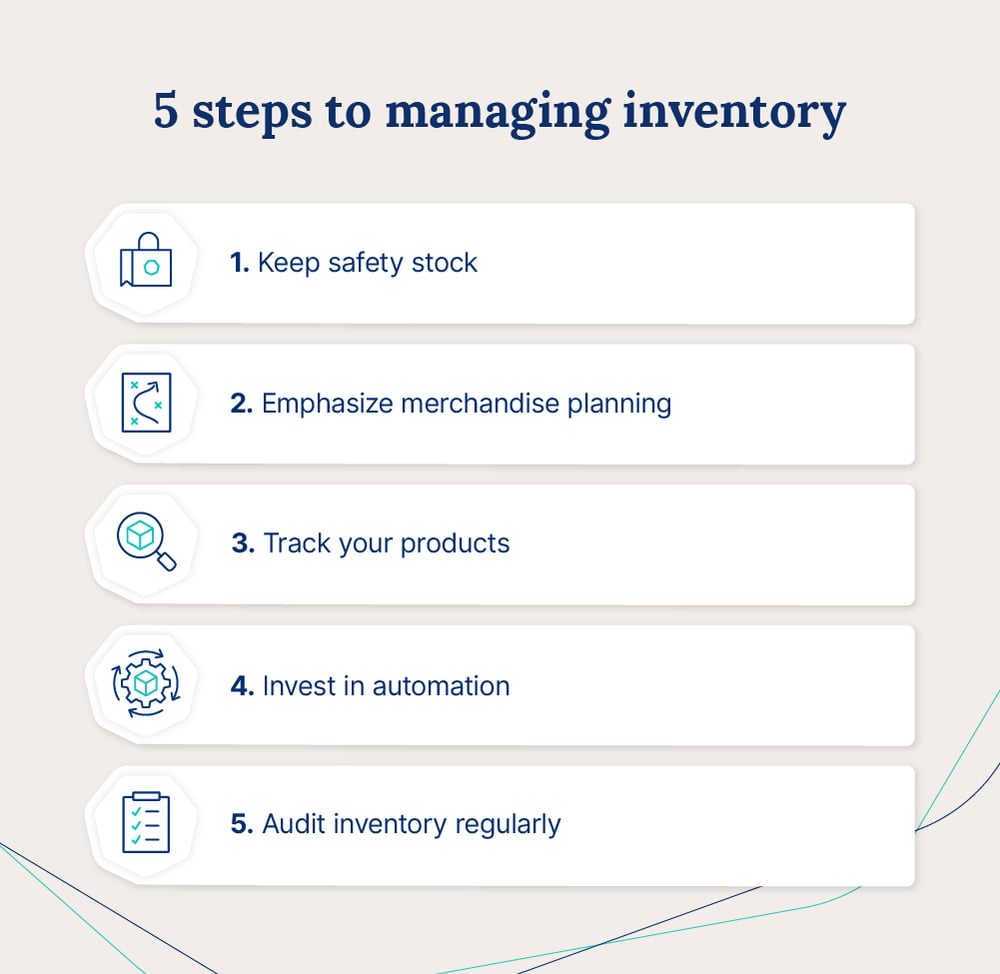
Step 1. Keep Safety Stock
Inventory is often stocked based on average demand. But a rush of sales could leave you out of stock before you can replenish. Keep safety stocks to mitigate stockouts when there is a high variation in demand and supply.
Step 2. Emphasize Merchandise Planning
Merchandise planning, or the strategic stocking, managing, purchasing, displaying, and pricing of products, can increase ROI and decrease inventory costs by:
- Lowering unwanted inventory in the warehouse
- Decreasing labor and maintenance costs
- Reducing obsolescence by selling more stock
- Lowering depreciation of inventory
Step 3. Track Your Products
The bread and butter of inventory management is tracking products at all times. You should be able to track a single item from when you order raw materials until the finished goods are in customers' hands. Create a tracking system for each step by identifying responsible parties, selecting a tracking method, and training employees.
Step 4. Invest in Inventory Automation
It's been said before, manually tracking inventory is a process that you'll likely outgrow fast. As your business expands, a more robust system is needed. Replacing manual management with connected inventory performance and systems allows automation and integrations to drive visibility, traceability, and efficiency throughout the inventory lifecycle.
It also offers solutions for understanding real-time insights and analytics on stock levels, sales trends, and more. Plus, cloud-based technologies connect point-of-sale bases that automatically update inventory levels after transactions and shipments. These systems also allow businesses to set up alerts for low inventory to avoid high-demand stockouts.
Step 5. Audit Regularly
Though inventory management software offers endless benefits, you should still periodically count your inventory levels to ensure your stock reflects the software's levels. Depending on your stock size, it may be best to schedule a thorough inventory review annually, biannually, or even quarterly.
Regular audits paired with systematic spot-checking may catch unexpected inventory shrinkage, improperly stored items, and more.
Manage Your Inventory Smarter with Cin7
If you've made it this far, you know that good inventory management isn't optional, it's the backbone of a healthy, growing business. But you don't have to tackle it alone. Whether you need POS and e-commerce integrations, streamlined fulfillment support, or real-time visibility across every channel, you need a system that actually delivers.
With two cloud-based solutions, Core and Omni, Cin7 was named the best overall inventory management software provider of 2023 by Forbes. Built to meet the inventory demands of small and mid-size businesses, these tools provide unprecedented insights into your inventory processes. They also support native EDI and 3PL connections for growing operations.
Our customers feel the difference. "Automations with Cin7 are huge and super helpful. They can't be underestimated or undervalued," says Ashley Gilbert, head of operations and business development for The Lip Bar.
Ready to manage your inventory more efficiently? Start your free trial today.
Frequently Asked Questions
Still have inventory management questions? We answer some of your most frequently asked questions below.
What Does Inventory Management Mean?
Inventory management is how you track, organize, and control every item your business buys, stores, and sells. It covers everything from sourcing raw materials to shipping finished goods to customers. The goal? Having the right products, in the right amounts, at the right time.
What Are the Four Types of Inventory?
The four main types of inventory refer to raw materials, work-in-process inventory, MRO inventory, and finished goods.
How Do You Reduce Inventory Costs?
You can reduce inventory costs by investing in an automated inventory management system, centralizing stock, setting reorder points, eliminating deadstock, and avoiding overstocking.
What Is the 80/20 Rule in Inventory?
The 80/20 inventory rule, also known as the Pareto Principle, states that roughly 20% of your product range typically drives 80% of your sales. Outside of inventory, it suggests that 20% of customers drive 80% of profits.
So what does that mean for you? Focus your attention (and your reorder budgets) on that top 20%. Those are the products you can't afford to run out of.
Can You Use Excel for Inventory Management?
You can use Excel for inventory management, but most businesses outgrow this solution very quickly. Tracking inventory through spreadsheets is a manual, time-consuming process. There's a greater chance of human error and security breaches when relying on Excel spreadsheets for inventory management.
What Problems Does Inventory Management Software Solve?
Good stock control helps you solve problems related to inefficient inventory handling. These can include difficulty scaling your business, costly manual errors, over- or understocking, and excess data capture.
Why Use Inventory Management Software?
Because manual tracking is a full-time job that still makes mistakes. Inventory management software automates the repetitive stuff, reorders, stock counts, sales tracking, so your team can focus on growing the business instead of chasing spreadsheets. It also connects with tools you already use, like your e-commerce platform, POS, and accounting software, so everything stays in sync without the headaches.
What Are Red Flags in Inventory Management?
Red flags that your stock control needs attention include rising carrying costs, frequent stockouts, and growing deadstock. Also watch for increasing customer complaints about fulfillment and a declining inventory turnover ratio.
If you're spotting any of these, your current processes or tools aren't keeping up. It might be time to invest in a more robust inventory management system.
What Are the 4 Types of Inventory Management?
The four main types of inventory management are just-in-time (JIT), materials requirement planning (MRP), economic order quantity (EOQ), and days' sales of inventory (DSI). Here's a quick breakdown:
- Just-in-time (JIT): You order stock only when you need it, keeping excess inventory, and carrying costs, to a minimum.
- Materials requirement planning (MRP): Stock orders are tied to your production schedule, so you always have what you need to manufacture on time.
- Economic order quantity (EOQ): A formula that helps you find the ideal order size to minimize both ordering and storage costs.
- Days' sales of inventory (DSI): Measures how long it takes to sell through current stock, useful for spotting slow movers early.
Not sure which method fits your business? Check out our inventory management techniques guide to find the right match.
Is Inventory Management a Skill?
Yes, inventory management combines analytical thinking, attention to detail, and understanding of supply chains and customer demand. The right inventory management system automates reorders, flags low stock, and generates reports so your team can focus on strategic decisions rather than manual tracking.
More from the blog
View All Posts
Complete Guide to Small Business Inventory Management for CPGs
Read More
Top 10 Inventory Management Rules for Your Business
Read More
